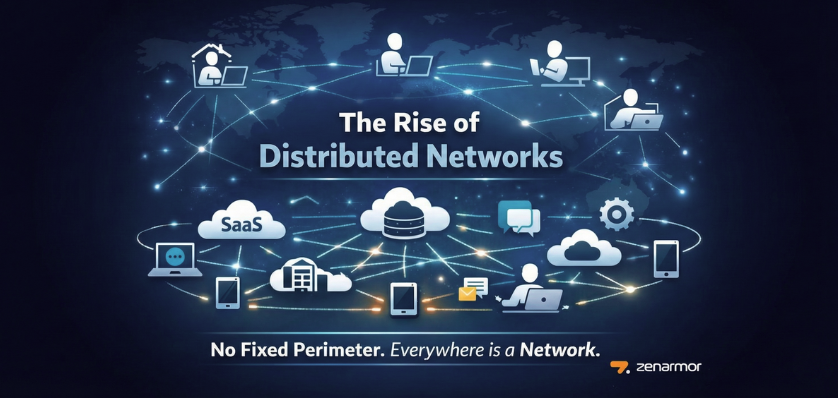
Network security has long assumed that networks were distinct places, such as offices, branches, and data centers. This shaped how data flowed and how security protected it. But in today’s distributed reality, what constitutes a network is wherever work is happening.
Remote employees face the same architectural challenges that branch offices once did. They connect from open networks, access multiple cloud and SaaS platforms, and pull critical resources from many places. Each endpoint they access has its own traffic patterns, trust decisions, and risk profile.
The new distributed reality has turned every endpoint into its own network, and security models designed for centralized control can fracture, revealing gaps that attackers can exploit.
The Myth of the Centralized Network
Traditionally, network security was built around the concept of control through concentration. Users, applications, and data could be put in a small number of trusted locations, and IT and security teams could inspect traffic and enforce policies from the perimeter. Firewalls, VPNs, and other security software all emerged from this concept.
In this world, a network had an inside and an outside. Users worked from inside offices. Applications lived inside data centers. Security tools protected data from attackers on the outside.
But as cloud services, SaaS platforms, and remote work have become a necessary part of our distributed world, traffic no longer flows through a single chokepoint. Applications moved to the outside of this perimeter, and “inside” lost all meaning.
Many security solutions still cling to this idea of a single chokepoint, forcing distributed activity through a central control that can’t adequately handle a network that no longer has a center.
From Branch Offices to Infinite Edges
In our new distributed reality, applications no longer reside in data centers. SaaS platforms are now the default way for collaboration, finance, and operations. Business infrastructure now resides on the cloud. Users, contractors, and third parties access critical systems without ever setting foot inside an office.
What has replaced the traditional branch office is infinite edges, when networks stop having a fixed boundary. Every user, device, and workload is now its own access point, generating traffic that moves in multifaceted, unpredictable paths to the internet, cloud services, and APIs.
Traditional network boundaries have simply dissolved.
Traditional SASE Was Designed for a Different World
Secure Access Service Edge (SASE) was developed to modernize security for distributed networks. Instead of scattered endpoints, it promised a unified, cloud-delivered security model. But many assumptions from early SASE architectures came from old, outdated models they were meant to replace.
These models depend on redirected traffic to a centralized, limited number of cloud inspection points, sometimes very far from where these connections originate. Similar to the old hub-and-spoke model, this has simply moved the data center to the cloud.
This made sense when remote access was the exception and traffic volume was predictable. But today’s distributed-first environments are anything but predictable. With an outdated SASE model, traffic is forced onto indirect paths, where latency and performance issues become a problem.
The other assumption with traditional SASE is that security improved with everything funneled through one location. In distributed networks, this assumption is no longer valid.
Understanding Latency as a Security Risk
It is easy to see latency as strictly a performance issue, something separate from security. But in distributed environments, the line separating the two has blurred. If security controls cause traffic to slow down, that changes how users behave.
Users see friction as a problem, and inevitably seek workarounds. When deadlines loom, they may bypass security tools and move files through unsanctioned tools, or disable protection when possible. What began as a performance issue turns into a policy failure.
Forcing traffic through a centralized inspection point amplifies this risk. This can add delay, especially for SaaS applications and real-time services that demand low-latency connections.
In the new distributed model, security that slows down work gets avoided.
The Hidden Cost of Forcing All Traffic Through the Cloud
Routing all traffic through a single centralized cloud inspection point for simplification purposes may indirectly introduce complexity, albeit one that is harder to see until performance and reliability begin to suffer.
Backhauling traffic through a distant inspection point can result in data traveling through indirect paths to reach its destination. Inspection points can turn into bottlenecks, especially during peak usage times, and can cause inconsistent performance for users and applications.
Instead of following the most direct path to a SaaS service or cloud workload, data is forced through one hub that can fail or slow down.
What might appear as centralized and clean on paper often turns into a network quagmire that undermines both performance and security resilience.
Highly Distributed Environments Change the Threat Model
When networks were static and centralized, location was used to verify trust. Users inside the office or behind the firewall were inherently trusted. But in distributed environments, location has no meaning. Users connect from anywhere, applications are accessed from the cloud, and traffic is routed through many different locations.
This has scrambled the threat model. Instead of relying on where a connection comes from, security models now must look at who is making it, under what conditions, and for what purpose.
The distributed model means continuous verification must be enforced. Trust is not established just once; connections must be evaluated dynamically as conditions change and new resources are accessed.
Why One Remote User is a Network
Remote access used to be seen as a temporary tunnel to a corporate network. A user logged in, accessed what they needed, and then returned to the in-office topology.
In today’s world where work is distributed, this no longer holds. Modern architectures understand that networks are no longer fixed locations, but wherever users, devices, and workloads operate from.
Every user engages with multiple devices, multiple apps, cloud services, identity providers, and resources remotely over the internet. Each interaction generates an independent connection point with trust decisions and contextual signals that must be evaluated continuously.
Security That Assumes Distribution from the Start
Modern network security understands that work, data, and users are dispersed across multiple regions instead of concentrated behind a single perimeter. Inspection of traffic and policy enforcement must happen where traffic actually flows, at the edge, in the cloud, or right at the endpoint, rather than funneled through a single centralized point.
Locating security controls closer to users and workloads reduces latency and eliminates inefficiencies. This approach makes it easier for security teams to enforce consistent policies without sacrificing performance.
Adopting a distributed-first mindset paired with identity-centric security means that access decisions are based on who or what is connected, not where they are located.
The Mid-Market Reality: Small Teams and Limited Budgets
Most mid-market organizations do not have large, dedicated security teams or unlimited budgets. Network and security issues usually reside with a small group of generalists who already manage many other things for day-to-day operations. Complexity in such an environment is unsustainable.
Network architecture that needs constant tuning and specialized expertise only adds to risk. When tools are hard to deploy and operate, this can lead to partial implementation and enforcement inconsistency.
Security must align with the available resources necessary to run it.
What to Look For When Evaluating Distributed Security Models
When evaluating distributed security models, be sure to consider architectural assumptions more than features. Always ask where enforcement actually happens. Models that rely on centralized choke points often cause the same problems they claim to fix.
Find out how identity and context are treated. More effective distributed models evaluate identity and context continuously, rather than relying on network location.
Be sure to consider performance as well. If the architecture introduces latency, it will encourage workarounds that undermines security policy.
Designing Security for the Network You Actually Have
You can design security for a centralized network but that doesn’t make your network centralized. Users, applications, and data are already distributed, and architectures that ignore this reality don’t fail loudly. They fail quietly, through latency, blind spots, and inconsistent enforcement.
This is where traditional SASE starts to break down. When security is built around assumptions instead of reality, complexity increases and protection weakens.
When network architecture aligns with how work actually happens, security becomes simpler to use, more consistent to enforce, and stronger where it matters most.